Hey solarDwellers:
So, the other day I was complaining in a post because California Public Utilities Commission is going to get less generous with the amount of rebate money people who install solar pv will get next year. The example I used: a nice-sized, 2.5kW single-home system net price could go up from $15,800 this year to $17,000 next year because of a lower state rebate, unless of course your nice, neighborhood installer decides to keep the price toward the lower end to keep demand high, with the effect of lowering his/her own profit margin.
And if these possible state-level changes weren't dizzying enough for installers and consumers, PG&E (the other shoe, the California electricity corporation), decided to change its electricity rate structure beginning May 1 of this year(2006).
The biggest change was in their "Time of Use" rate, which is the type of rate which most solar owners have chosen historically and found most beneficial economically for the solar power they sell "back" to PG&E during "peak hours." Anyone can choose a "time of use" rate, which just means the utility will charge you more for power you use between 12-6pm(peak hours), and charge you less for all other hours and weekends(off-peak). Doesn't sound good if you use much power during those peak hours. But if you have some nice solar panels on your roof, and you don't use much power during those peak hours, you get to EXPORT that power to PG&E at the HIGHER peak-hour rates, while you pay PG&E LESS for off-peak power at night.
This was a great deal for solar, because on the old "time-of-use" schedule, called "E-7" in PG&E language, in the Summer PG&E would pay or credit the solar owner for their solar electricity at $.29/kWh between noon and 6pm, and only charge that owner around $.09/kWH to use the utility's electricity outside those peak hours. This large differential for the solar owner between the price to sell and buy, in effect, made it possible to buy a PV system that produced only 65% of their electricity usage but REDUCED the electric bill by 95%. In other words, a PV system producing 65% of your electricity needs could produce 95% of economic savings.
Now, the problem: solar owners can't get the old "E-7" rate with such a wide differential between peak and off-peak prices. Now you have to go with the "E-6" rate schedule. Instead of earning $.29/kWH peak and paying $.09/kWh off-peak in Summer, the new rates are $.21/kWh peak and $.095/kWh off-peak. They're paying you less for your solar during the day and charging you more at night for power!!! What a deal!!
So, what's it all mean!? Basically, the magic of a PV system producing only 65% of your electricity but reducing your bill by 95% is not so magic any more, because the utility is buying your solar for less between those prime noon-6pm hours when solar panels produce at their best. The reality now is that you need a bigger, more expensive PV system than you would have needed under the old rate to get that same 95% economic savings benefit.
All in all, future solarDwellers, it's been a pretty disappointing double whammy from the state(potential reduced rebates) and the corporation(reduced price for your solar exports) at the same time. Don't get me wrong! This is just a bump in the road in the rebirth of solar in California and nationwide.
Buying solar for your abode still is guaranteed to pay you back on your investment and guaranteed to reduce your carbon footprint A LOT!!!! You'll be glad to know if you put a 2.5kW system on your house, it's roughly the carbon equivalent of not driving your car 10 months out of each and every year that your solar panels are on your roof. So, stick with your current car and buy solar instead of a new car, or try not driving for the 10 months out of every year . . . .You gotta do what works for you.
--the solarDweller
Categories: solar, solar+power, solar+energy, green+power, alternative, renewable, sustainable, economicsofsolar, psychologymarketing,
Showing posts with label WHY: The Psychology of Choosing Solar. Show all posts
Showing posts with label WHY: The Psychology of Choosing Solar. Show all posts
Monday, May 29, 2006


Thursday, April 27, 2006
First "Solar Spotlight" Interview by solarDweller

Metro Lighting and Crafts Store with solar, Berkeley, CA
Hey solarDwellers,
Welcome to my first installment of interviews I plan to do, talking to local people and businesses in the neighborhood that have taken that awesome, liberating and green step of going solar.
One thing I believe is that solar on roofs can be contagious as more people get curious when they see neighbors making that solar choice. The whole "tipping" point meme. I wanted a way to go further than seeing and posting photos of a new solar PV system, or a large roof with a bigger-than-average PV system in the S.F. Bay Area. So, I decided to talk to and get the first-hand experience of people living beneath those solar roofs, and let them talk about how they feel about solar, and if it has been positive both environmentally and economically for them.
So, for my first "solar-spotlight interview", I would like to highlight a
company called Metro Lighting, in Berkeley, CA that makes artisan lamp and lighting fixtures. When I first drove by their large grid of solar panels perched on their retail store roof, I thought, "Now there's a nice-sized PV system." It really made their "green building" stand out among the other industrial buildings on that block. And when I got closer and saw all those display fixtures inside, most of which the owners have diligently switched over to the energy-efficient, compact fluorescent kind, I immediately understood how that large electricity bill was probably crying out to the owners for some sleek solar panels up on the roof.
From their website, a little bit about the owners and their hand-crafted lamp designs: "Metro Lighting & Crafts was founded in 1993 by Lawrence Grown, and began as a restoration company for antique lighting fixtures. In time, Lawrence and his wife, Christa Rybczynski, who both hold degrees in Architecture, began using their
knowledge of lighting and architectural history to create new designs,
inspired and informed by Art Nouveau and Craftsman aesthetics."
Here's a side view of the roof with 100+ panels:
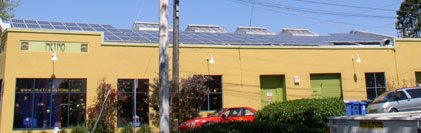
I spoke with Lawrence and Christa at their store and by e-mail about their year-old, commercial solar PV system as recorded in the following Q&A with them:
solarDweller: How long have you had your system?
Metro Lighting: It was one year last October/November 2005.
solarDweller: What size is your system and what percentage of your
electricity use was it designed to cover?
Metro Lighting: 19 kW. It was designed to cover 60% of our
store's electricity use.
solarDweller: How does its output compare to what your installer
predicted?
Metro Lighting: We are covering at least 60%, maybe even up to 70% of our electricity use.
solarDweller: How does your bill compare to what it was before?
Metro Lighting: It had been $800 to $900/month before solar. For
last year it averaged only $300/month.
solarDweller: How long did your installer estimate it will take
for the system to pay for itself?
Metro Lighting: About 5-6 years
solarDweller: How did you get the idea to put solar on?
Metro Lighting: The monthly bill was a constant reminder of how
much energy we were using. We tell our kids to turn off the
lights when not in use at home, but we need to have our display
fixtures lit all day. I guess it was just a matter of time
until we felt we could afford the investment.
solarDweller: What was your principal motivation? Ratio of
economics/environmental benefit. (50/50? 30/70? 70/30?)
Metro Lighting: About half for economics and half for the environment.
solarDweller: What was the biggest barrier/worry to making the
decision to purchase your solar PV system?
Metro Lighting: The initial outlay of cash, and the fact that we
don't own the building.
solarDweller: If you don't own your building, what did you have to
do to convince the owners? (Gordon Commercial Real Estate)
Metro Lighting: It was much simpler than I had thought. The
owners were also interested right away, we just needed to work
out the details. We wrote an addendum to our lease saying that
we owned the system and could choose to take it with us if we
leave. The installer is liable for any roofing issues.
solarDweller: How do you feel now that you have it?
Metro Lighting: Pleased and proud.
solarDweller: Have you thought of marketing yourself as a green
business to differentiate yourself from competition?
Metro Lighting: We have applied to the Alameda County Green Business Certification program, but they have a big backlog. I'm not sure when we'll be able to officially call Metro Lighting an Alameda County Certified Green Business, but that will be an exciting day. We also have a new line of compact fluorescent lighting fixtures for further energy conservation. We've swapped out many of our display bulbs from 25 watt incandescent to 5 watt screw-in compact fluorescents as well. I'm hoping when it gets sunny that our meter will spend more time running backwards.
solarDweller: Do many people notice or ask you about your solar PV
system?
Metro Lighting: Not that many people have mentioned the system, actually. At first there were a lot of comments, but not many anymore. That's fine, really. We want to do the right thing, but we are not in the solar business, and we don't mind sticking to the work at hand of designing, building and selling quality lighting.
That pretty much said it all, and I was glad to get such positive feedback and feelings about solar from a true solar PV owner. I liked the short payback period, and the fact they FEEL so good about having that solar there helping them make green energy for their business. I was also pleasantly surprised to hear that what could be seen as the big hurdle of convincing Gordon Commercial to let them do solar, that it was just a matter of adding language to the lease and getting the guarantee from the solar installer.
It's great to see a small business doing "the right thing" in the neighborhood, carrying out their artistic endeavors while keeping our air that much greener and cleaner! And, don't worry: their neighbors will get that solar envy, and hopefully follow the great example being set by Metro Lighting of Berkeley. Check out their website www.metrolighting.com the next time you need some nice lighting solutions. You'll feel good about your green purchase!
--the solarDweller
And now, for the really solar curious . . .
Some pictures of the inverter AC output and DC-AC calculations:
Their system runs off 5 Sharp 3500 watt Sunvista inverters, which means their theoretical maximum AC output is 17,500 watts or 17.5kW. Remember, these are fed by 19,000 watts or 19kW of DC power from the panels before the electricity gets converted to AC by those inverters. Electricity gets "lost" as it passes through the conversion process in the inverter. Lawrence and Christa can check out the system's AC production at any time by looking at the following displays, one for each inverter:
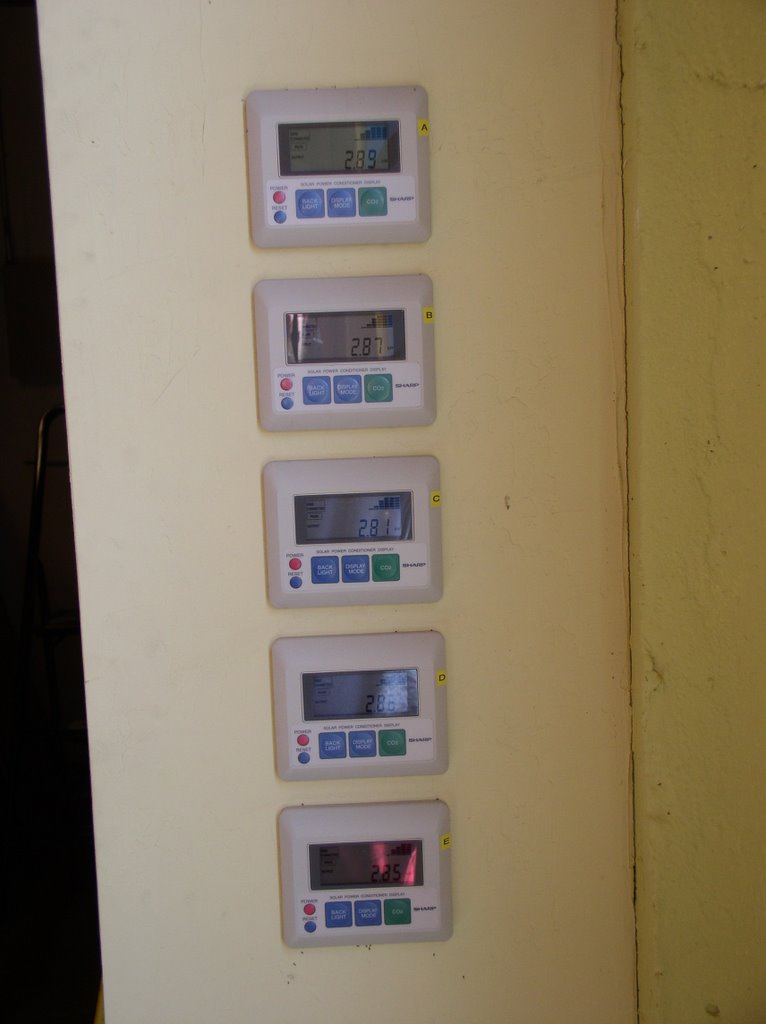
And a close-up of one of the displays:

The amount of DC going into that inverter from the DC panels started at 3.8 kW (19kW total panels/5 inverters), but the monitor in the photo, which we checked at high noon(solar time) on a sunny day, reads only 2.88 kW AC, not the "theoretical" max AC output from the Sunvista 3500 inverter of 3.5 kW. Why? Well, the old reality that you "lose" some of the electricity as it travels from the panels to the inverter, and then again when it passes through the inverter. The important number when you're buying a system is to try to figure the "real world" efficiency, or what percentage of the total DC rating of your panels gets converted into the AC output as it comes out of the inverter.
2.88 kW AC output / 3.8 kW of DC panels = 76%
You buy 3.8 kW worth of DC panels, and you get 2.88 kW of usable AC out of them. This is just the reality of efficiency loss when converting DC to AC. Many people OVERESTIMATE how much AC electricity their DC panels will produce. It's an easy mistake. If you buy 3.8 kW of panels and just multiply by an inverter which is 92% efficient, you'll overestimate your AC: 3.8 * .92 = 3.5 kW. To account for the total efficiency loss in the wiring, dust on the panels, etc, it's safer to count on an efficiency of 75-80% from the panels' total DC rating. I usually go with 77%, assuming direct sun, panels tilted at latitude and no significant shading. So, in the case above, just take your 3.8 kW of panels going into one inverter and multiply:
3.8 kW * .77 = 2.92 kW AC output, which is very close to the 2.88 kW "real-world" reading we saw in the photo of the single monitor above.
Use the lucky "77" efficiency number when you try to estimate the output of your solar panels and you'll come pretty darn close to reality. It's better to be pleasantly surprised that your system produces a little more than your conservative estimate than to be disappointed about what was an overly-optimistic efficiency estimate.
Hasta la próxima, solar people, and hope this post was useful!
Categories: solar, solar+power, solar+energy, renewable, alternative+energy, sustainable, tips, calculations, solarsightings, psychologymarketing
Subscribe to:
Posts (Atom)